top of page

CANISSAGE FOR PROFESSIONALS
Supporting canine comfort, mobility and recovery
Gentle Cycloidal Vibration Therapy (CVT) designed to complement vet led rehabilitation, mobility support and professional canine care. Canissage provides a calm, controlled approach that can be incorporated into tailored care plans, helping veterinary and rehabilitation professionals support canine comfort, movement and quality of life at every stage of recovery.

UK Manufactured
Professional support
Two year guarantee
Ongoing guidance
DESIGNED FOR CANINE CARE SETTINGS
A practical addition to your professional toolkit
Canissage Pulse can be incorporated alongside professional assessment, hands on treatment, prescribed exercise and canine conditioning. Gentle Cycloidal Vibration Therapy (CVT) provides a calm, comfortable resting experience while supporting muscle relaxation, circulation and preparation for movement.

Veterinary rehabilitation
Provide calm, comfortable support before, between or after prescribed rehabilitation sessions as part of an individually directed care plan.
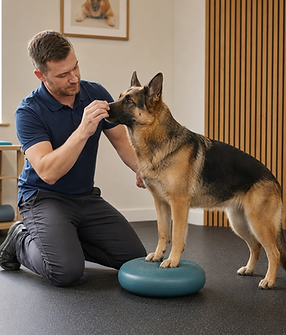
Canine physiotherapy
Integrate gentle CVT alongside hands on treatment and prescribed exercise to support relaxation, preparation for movement and post session recovery.

Hydrotherapy centres
Use Canissage before or after pool and underwater treadmill sessions to support warm up, relaxation and a more complete recovery routine.

Working and sporting dogs
Incorporate CVT into structured warm up, conditioning, cool down and post activity recovery routines for active and performance dogs.
Canissage is intended to complement, not replace, veterinary diagnosis, prescribed treatment or professionally directed rehabilitation.
HOW IT FITS INTO PROFESSIONAL CARE
From professional assessment to supported home use
Canissage can form part of a vet or therapist led care plan, giving owners a clear and responsible way to continue supporting their dog between appointments. It is designed to complement, not replace, veterinary treatment, rehabilitation and appropriate exercise.
Confirm suitability
Review the dog’s condition, care objectives and contraindications, establishing where Canissage may appropriately complement the existing veterinary or rehabilitation plan.
Introduce at low intensity
Allow the dog to settle comfortably on the pad before CVT begins. Start on a low setting and increase gradually only as the dog becomes accustomed to the therapy and responds positively.
Match use to the objective
Choose the setting, duration and timing to suit the intended purpose, from relaxation and everyday mobility support to rehabilitation, warm up or post activity recovery.
Monitor and adapt
Review the dog’s comfort, behaviour, movement and tolerance over time. Adjust or pause use when required and seek veterinary advice if the dog’s needs or condition change.
THE TECHNOLOGY
Gentle three-dimensional motion, applied with a clear purpose
CVT Technology
Canissage Pulse delivers Cycloidal Vibration Therapy (CVT) through the surface of the pad while the dog rests comfortably. Unlike simple single direction vibration, its gentle three-dimensional motion creates a consistent and controlled therapy experience designed to support circulation and encourage muscle relaxation.
Canissage can be used both within professional canine-care settings and by owners at home. Veterinary, rehabilitation and canine professionals can incorporate it into appropriate mobility, warm-up and recovery routines, or recommend continued home use between appointments.
Intensity, timing and duration can be introduced gradually and matched to the individual dog’s needs, tolerance and intended use.

Supports circulation
Gentle cycloidal movement supports healthy blood flow while the dog remains comfortably at rest.

Encourages muscle relaxation
The calming, rhythmic motion can help muscles relax before treatment, activity or recovery.

Complements rehabilitation
CVT can sit alongside professionally directed treatment, prescribed exercise and conditioning.

Suitable for continued home use
Canissage gives owners a practical way to support their dog at home, whether purchased independently or used as part of a professionally recommended routine.
Canissage is intended to complement, not replace, veterinary diagnosis, prescribed treatment or professionally directed rehabilitation.
EVIDENCE AND PROFESSIONAL CONFIDENCE
Clear about what the evidence shows
Canissage Pulse is built around Cycloidal Vibration Therapy, a form of localised mechanical stimulation. Research in human rehabilitation and general physiology provides a scientific rationale for exploring how vibration may influence sensory processing, circulation and muscle response.
That wider research is not the same as product-specific evidence in dogs. For professionals, confidence comes from understanding each level of evidence, selecting cases appropriately and monitoring the individual dog within its wider care plan.

Evidence
THE EVIDENCE
A transparent view of the evidence
Mechanical vibration has been investigated across neurophysiology, circulation, muscle function and physical rehabilitation. This wider body of research provides scientific context for understanding how controlled mechanical stimulation may interact with sensory processing, neuromuscular response and peripheral circulation.
However, vibration is not a single, uniform intervention. Its effects may vary according to frequency, amplitude, direction of movement, contact area, session duration and method of application. Findings from human research, laboratory studies or trials involving other canine vibration devices should therefore not be presented as direct evidence of the clinical performance of Canissage Pulse.
To communicate the evidence responsibly, we distinguish between three levels:
01
Wider scientific evidence
Human, laboratory and physiological research has examined how localised and whole-body vibration may influence sensory modulation, neuromuscular activity, circulation and recovery.
This research helps establish a scientific rationale for therapeutic vibration, while also demonstrating that outcomes depend significantly on the way the vibration is delivered.
02
Emerging canine research
Published canine studies have begun to examine localised and whole-body vibration in areas including mobility, muscle condition and owner-reported pain measures.
The early findings are encouraging, but the current evidence base remains limited. Studies have generally involved small populations, different devices and varying treatment protocols. Further randomised, blinded and independently replicated research is needed.
03
Canissage specific evidence
Evidence obtained using other vibration systems should not automatically be attributed to Canissage Pulse.
Professional observations, owner feedback and Canissage case studies can provide valuable insight into practical use, tolerance and individual response. They should be presented transparently as real-world experience rather than as equivalent to controlled clinical research.
Any clinical efficacy claims made specifically for Canissage Pulse should be supported by appropriately designed product-specific studies.
Applying the evidence in practice
When incorporating Canissage into a care plan, define the intended objective, record the programme setting and session duration, and monitor agreed measures such as comfort, tolerance, movement and post activity recovery.
Review the dog’s response over time and adapt or pause use where appropriate. Changes in the dog’s condition should be discussed with the veterinary or rehabilitation team.
Canissage is intended to complement, not replace, veterinary diagnosis, prescribed treatment or professionally directed rehabilitation.
A considered option within multifaceted canine management
Research
Supporting canine comfort, mobility and recovery rarely depends on one intervention alone. UK veterinary-led resources advocate an individual, multimodal approach that can bring together veterinary treatment, rehabilitation, appropriate exercise, weight management, environmental adaptation and informed owner participation.
Within this wider framework, localised vibration is a developing area of professional interest. Canissage Pulse provides a practical way to introduce gentle Cycloidal Vibration Therapy while the dog rests, either in a professional setting or as part of an appropriately supported home routine.
The UK professional context
Canine Arthritis Management, a UK veterinary-led organisation, promotes early identification, ongoing assessment and multimodal management. Its resources describe physical rehabilitation, complementary therapies, modified exercise and home environment adaptations as elements that may be combined within an individual dog’s management plan.
What published canine research currently shows
A 2024 multicentre, prospective study evaluated localised vibration in 37 dogs with bilateral hip dysplasia. A handheld vibration device was applied daily for 14 days while medication, supplements, other rehabilitation treatments and activity levels remained unchanged.
Owner completed Canine Brief Pain Inventory scores for pain severity and pain interference decreased during the study. Using the researchers’ predefined response criteria, 62% of dogs responded after seven days and 73% after 14 days.
The findings are encouraging, but require careful interpretation. The outcomes were owner reported, the research was not randomised or blinded, and the device and treatment protocol were different from Canissage Pulse. The authors recommended further randomised and blinded studies.
A developing scientific rationale
A 2022 systematic review examined human and animal research into localised vibration and pain processing. It concluded that the response is more complex than the traditional spinal “gate control” explanation alone.
The review found that the physiological response may vary according to factors including vibration frequency, intensity, application site and the sensory receptors being stimulated. This provides a rationale for continued investigation while demonstrating why findings from one vibration system should not automatically be attributed to another.
Where Canissage fits
The available research does not establish that Canissage Pulse will produce the same outcomes as the handheld device evaluated in the 2024 canine study. It does, however, demonstrate that localised vibration is being investigated directly in dogs and that its use can be incorporated into a structured, monitored home management protocol.
Alongside the wider physiological research, this provides a credible basis for professionals to consider whether gentle vibration could complement an individual dog’s existing care, rehabilitation or conditioning plan.
Canissage offers a practical resting surface format that can be used in the clinic or continued at home. This may help owners follow a consistent routine between appointments, with the programme adapted according to the dog’s objective, tolerance and professional guidance.
Applied with a clear objective
When considering Canissage, establish:
-
The reason for introducing CVT
-
The dog’s suitability and any relevant contraindications
-
The appropriate programme, setting and session duration
-
Whether it is being used before activity, after activity or during rest
-
How comfort, tolerance, movement and recovery will be monitored
-
When use should be adjusted, paused or referred for veterinary review
Canissage should be viewed as a complementary management option. It is not intended to replace veterinary diagnosis, prescribed medication, professional rehabilitation or appropriate exercise.
CANISSAGE IN PRACTICE
Real experience within an ongoing care plan.
Mouse, a young Munsterlander, developed complex joint problems and underwent surgery on both elbows and his left shoulder. Annabelle now manages his needs through veterinary care, physiotherapy, hydrotherapy and carefully controlled exercise.
Annabelle introduced Canissage as part of Mouse’s home routine, particularly after walks and activity, giving him a comfortable place to settle and rest.
Annabelle's observation
"Mouse gets onto the Canissage pad without encouragement and sometimes chooses to sleep there."


Hear Annabelle tell Mouse's story
Owner video - 46 seconds
PUTTING CANISSAGE INTO PRACTICE
From professional introduction to supported home use
Usage
A clear handover helps owners use Canissage consistently between appointments, with the programme, timing and intended objective set around the individual dog.
01
Introduce in practice
PROFESSIONAL SETTING
Confirm suitability, allow the dog to settle on the pad and introduce CVT gradually. Define the reason for use and the response that will be monitored.
02
Continue at home
OWNER HANDOVER
Give the owner clear guidance on programme, intensity, session duration and timing, together with practical instructions for safe and consistent use.
03
Review and Adapt
ONGOING REVIEW
Discuss comfort, tolerance, movement and recovery at follow-up. Adapt or pause use when appropriate and refer for veterinary review if the dog’s condition changes.
Canissage is intended to complement, not replace, veterinary diagnosis, prescribed treatment or professionally directed rehabilitation.
PROFESSIONAL PARTNERSHIPS
Recommend with confidence.
Benefit through partnership.
For professionals who choose to recommend Canissage where it is appropriate for an individual dog, our Referral Partner Programme provides a straightforward route to support continued home use. Approved partners receive a unique referral code, earn commission on qualifying purchases and have ongoing access to information and support from the Canissage team.

10% commission
On qualifying purchases made when your code has been used.

Unique referral code
A simple route for clients purchasing for home use.

Ongoing partner support
Product information and help from the Canissage team.
Recommendations should always reflect the individual dog’s needs and wider care plan. Any financial interest should be communicated transparently to the owner.
PROFESSIONAL FAQs
Practical questions, answered clearly
Guidance for professionals considering Canissage within canine care, rehabilitation, conditioning or supported home use routines. Suitability and use should always be considered in relation to the individual dog, the intended objective and the wider care plan.
If you have additional questions you can book our FREE online consultation or simply call to speak to a member of the team on freephone 0800 689 9820.
PROFESSIONAL SUPPORT
Explore how Canissage could fit into your practice
Whether you are considering Canissage for use within your professional setting, recommending supported home use or simply want to understand the technology in more detail, our team is here to help.
FREE PROFESSIONAL CONSULTATION
A practical conversation with our team

45 minutes
Google Meet
Explore use within your professional setting
Discuss supported home use and owner handover
Ask practical product and implementation question

bottom of page